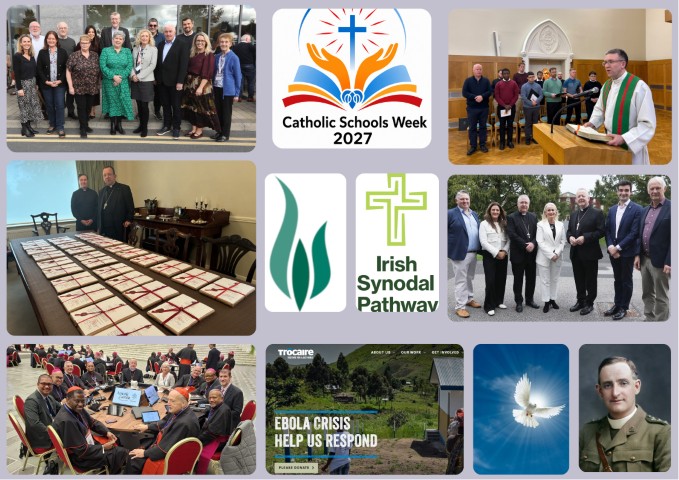
Members of the Irish Catholic Bishops’ Conference gathered this week at Saint Patrick’s College, Maynooth, for their Autumn 2026 General Meeting. The President of the Conference is Archbishop Eamon Martin of Armagh, and the Vice-President is Archbishop Dermot Farrell of Dublin.
On the first day of the conference, bishops concelebrated Mass in Saint Mary’s Oratory of Saint Patrick’s College. Chief celebrant Archbishop Martin offered prayers for families and neighbours across Ireland who have experienced intimidation, injury and death due to violence in their local community – in particular for the English family of Waterford City whose funeral Mass took place this week; for peace in the Holy Land, and for all people suffering in conflict zones throughout the world. In particular, bishops welcomed the initiative of Pope Leo XIV over recent days in contacting President Putin of Russia and President Zelensky of Ukraine to urge them to allow food and medical aid to reach civilians in Oleshky, in the Kherson region, and for the safe evacuation of the civilian population there. Bishops have announced that the Catholic Church in Ireland will hold a national day of prayer for peace in Ukraine on Wednesday 24 February 2027, to mark the fifth anniversary of Russia’s full-scale invasion of Ukraine.
Prayers were also offered for the full recovery of Pope Leo following his recent surgery in Rome.
Items for discussion during Irish Catholic Bishops’ Conference Autumn meeting included:
- Universal Church encounter ‘Ten years of Amoris Laetitia: Proclaiming the Gospel with Families Today’
- Praying for continued peace in Northern Ireland
- Taking the next steps following the National Synodal Assembly of the Irish Synodal Pathway
- Update from the National Board for Safeguarding Children in the Catholic Church
- Bishops: “Migration is good for the Church and the economy”
- Irish Inter-Church Meeting on the theme
- Trócaire report: plight of Christian community and prevention of humanitarian aid in Gaza; Ebola virus in DR Congo
- 40th anniversary of the historic Assisi peace meeting on 27 October
- Bishops express concern at UNIFIL mandate in Lebanon being discontinued
- Bishops call for alternative forms of rehabilitation for those convicted of crimes
- Bishops call on EU delegation to advocate for a just transition from fossil fuels at COP31
- Cause for Canonisation of Father Willie Doyle SJ
- ‘Living Magnifica Humanitas’ – conference on safeguarding humanity in the AI era
- Catholic Schools Week 2027
See below details of these main items:
- Universal Church encounter marking ten years of Amoris laetitia: ‘Proclaiming the Gospel with Families Today’
During the celebration of Mass on the first day of the Autumn General Meeting of the Irish Catholic Bishops’ Conference, Archbishop Eamon Martin delivered to bishops his reflection on his attendance last week in Rome at the meeting hosted by Pope Leo XIV, to mark ten years since the publication of Pope Francis’ Apostolic Exhortation on love in the family, Amoris Laetitia.
- Praying for continued peace in Northern Ireland
Bishops prayed that political and community leaders in Northern Ireland would double down on working for reconciliation and not allow a return to the wounds and tribalism of the past, stating, “We note, with thanks to God, the work of clergy from so many Churches in the Portadown area in recent weeks to help diffuse a difficult situation. This reminds us yet again, that the road to lasting peace must be rooted in respect, justice and an authentic search for true and lasting reconciliation.”
- Taking the next steps following the National Synodal Assembly of the Irish Synodal Pathway
The Irish Catholic Bishops’ Conference welcomed the statement and recommendations from the National Synodal Assembly, held in Gormanston, County Meath, on 17 October 2026. The gathering was an important milestone in the life of the Catholic Church in Ireland and marked a significant step in its journey towards becoming a more Gospel-centred listening, inclusive and mission-focused Church.
The Assembly brought together lay women and men, young and older people, religious sisters and brothers, deacons, priests and bishops. Participants spent the day praying, listening, discussing and discerning together. Their conversations reflected five years of preparation, dialogue and hard work, bringing together people with different experiences and opinions but united by their faith in Christ and their commitment to the Church.
Although participants did not agree on every issue, there was a shared recognition that they belonged together and had a common mission. The Assembly combined a realistic understanding of the challenges facing the Church with hope for its future.
Several important themes emerged from the discussions. Participants expressed a strong desire for more opportunities to deepen their faith and understanding of Catholic teaching. They highlighted the need to make healing a priority in the Church’s ongoing work. They also called for more shared leadership and responsibility and greater recognition of women’s contributions, vocations and ministries within the Church. Particularly noted was the desire for stronger engagement with young people. Engagement with society and the value of the social teaching of the Church were also highlighted.
From listening to action
Bishops recognise that their responsibility now is to consider the recommendations carefully and respond faithfully to what participants have shared. This involves examining the proposals, written comments and contributions made during the Assembly’s open discussions. They must identify the wider direction emerging from the gathering while also considering how individual recommendations could work in parishes, dioceses and national Church organisations.
Bishops acknowledge that some proposals will require further discussion and discernment. Both the support for particular recommendations and the concerns expressed about them must be taken seriously.
A fuller report will be published to allow the wider Church to continue reflecting on the Assembly’s findings. However, the bishops have agreed that progress should not wait until the report is completed. They intend to bring proposals concerning parish and diocesan life back to their local communities, examine existing initiatives and identify where improvements or new approaches are needed.
Bishops will work with diocesan synodal teams and other Church groups to decide which recommendations can be implemented promptly. They also plan to share experiences across the Church’s four ecclesiastical provinces, allowing neighbouring dioceses to learn from and support one another.
Bishops stressed that synodality must grow from the participation, experience and gifts of people in local communities. It is not simply a process directed from the top but one that develops through the active involvement of the whole People of God.
The journey now moves into a phase of mission in action, all of us now committing ourselves “to contributing to the great mission of evangelization – which is always a work of love – according to our own vocation and the gifts we have received (Pope Leo XIV, Message of His Holiness Pope Leo XIV for the 100th World Mission Day 2026).” Some proposals are expected to progress quickly while others will require more time, planning and reflection.
The Assembly is therefore not the end of the process but the beginning of a new stage focused on putting its recommendations into practice. Bishops will also remain attentive to developments in the worldwide Synod on Synodality and any changes that may affect Church structures and practices.
As an immediate step, bishops agreed to review the work of parish and diocesan pastoral councils. They also committed themselves to further developing the ministry of Catechist, supporting people who help others understand and grow in their faith. A pilot project of training for this ministry is to begin in a number of dioceses in September 2027.
There was considerable support for recognising and developing the gifts and responsibilities of women within the Church, even where delegates differed about the particular structures through which this should happen. There was also a desire for practical change at the level of parish and diocese, rather than concentrating on establishing new national structures.
Gratitude and the road ahead
In his encouraging message to the Assembly, Cardinal Mario Grech, Secretary General of the Synod of Bishops, expressed his admiration for the Synodal process in Ireland and invited the Church to look now towards mission with renewed confidence. He recognised that progress may require abandoning familiar practices to make room for new approaches. The focus is mission rather than concentrating on managing decline. All of this is part of “the shift from maintenance to mission” to which the Church is called at this time.
Bishops also expressed gratitude to everyone who contributed to the Synodal Pathway, particularly those who shared personal experiences, facilitated conversations and served on diocesan and national teams. They also thanked Father Declan Hurley, chairperson of the National Synodal Team, and Julieann Moran, General Secretary of the Irish Synodal Pathway, alongside all those who helped organise the Assembly.
- Update from the National Board for Safeguarding Children in the Catholic Church
Mr Aidan Gordon, chief executive officer, and Dr Keith Holmes, chairperson, of the National Board for Safeguarding Children in the Catholic Church in Ireland, updated bishops on the work of safeguarding children across the Church on the island.
The Commission of Investigation into the handling of child sexual abuse allegations in schools
It was noted that the Commission of Investigation into the handling of child sexual abuse allegations in schools, under Justice Michael McGrath, has written to the Bishops’ Conference to inform it of the commencement of the Commission’s work. The Commission has now established its own website and is preparing to issue its questionnaire to all schools which come under their remit. The charity One in Four has been appointed to assist the Commission in its engagement with victims and survivors, and Mr Gordon has communicated the contact details of the Church agencies Towards Peace and Towards Healing to One in Four.
Reviews of Safeguarding in the Catholic Church in Ireland
Bishops were updated on the plans for the recruitment and training of Independent Reviewers to assist with the forthcoming reviews of Safeguarding Practice in Church Bodies. Church authorities will be contacted over the coming weeks to commence the process of agreeing terms of reference for the Independent Reviews under the revised Child Safeguarding Policy A Safe and Welcoming Church, which commenced in June 2024. This initiative will be the third tranche of Independent Reviews carried out by the National Board.
Updated Guidance
Bishops were also advised that, over the summer, the National Board has updated various pieces of guidance in consultation with the Tusla Compliance Unit and the Professional Officers of the Safeguarding Board for Northern Ireland.
National Safeguarding Conference 2027
The next NBSC national conference will take place next year on the theme ‘Promoting a Culture of Safeguarding’ on 13 and 14 October 2027 in the Shearwater Hotel, Ballinasloe.
Bishops thanked the National Board for hosting a special online session on 7 October with Professor Jörg M. Fegert, co-author of Protecting and Empowering Minors in a Digital World, who is with the European Commission’s Special Panel on Child Safety Online provides an important evidence base for understanding the risks children face in digital environments and the responsibilities of organisations working with young people. This session offered Church Leaders and Safeguarding Leads valuable insights into current European policy developments and practical approaches to strengthening online safety.
- Bishops: “Migration is good for the Church and the economy”
Bishops received a report from the Council for Migrants, Refugees and Justice & Peace on the contribution made by migrants to both the Church in Ireland and the economy.
Bishops said, “Migrant people are a welcome presence in so many parishes today, where their vibrancy, prayerfulness and contribution are greatly valued. Migrants bring to our parishes and dioceses new perspectives from their own cultures and traditions which enrich the life and vitality of our faith communities in so many ways.
“Similarly, the contribution of migrants to the Irish economy is to be welcomed. Indeed, without their input many of our frontline services in healthcare, hospitality, retail and so many other sectors would not survive. The Bishops’ Council cited recent ESRI research (2026) which found that ‘migrants entirely finance their own share of public goods’, and that immigrants have made a higher fiscal contribution than Irish-born residents over the past two decades. The report indicated migrants in Ireland are younger and more likely to be employed than the non-migrant population, contributing to their positive impact on public finances.
“We are concerned at a progressive hardening and polarisation in Ireland on asylum and migration. Myths and misinformation on these issues are widely disseminated, and especially so online. It is only just and fair that public opinions and attitudes are informed by evidence and facts.”
“Misinformation has real life consequences. Inflammatory assertions fuel fears for safety in communities and heighten perceived risks from specific cohorts of migrants,” Bishops said.
Recalling their 2024 Pastoral Letter, A Hundred Thousand Welcomes?, the bishops reiterated that, “There is a need to counter negative narratives and disinformation through direct encounter and building on Ireland’s tradition of hospitality. Ground up approaches show how hospitality can positively connect local and migrant communities. Direct encounter can change hearts, minds and perspective.
“As Pope Leo said in his recent World Day of Migrants and Refugees message: ‘An urgent change of perspective is needed… from the mere management of migration flows to the full and immediate protection of human rights.’”
- Irish Inter-Church Meeting on the theme
The Irish Inter-Church Meeting will take place on 5 – 6 November in the Society of African Missions’ Dromantine Retreat Centre, Co Down, bringing together representatives of many Churches and communities across the island of Ireland. This year’s Inter-Church Meeting will be exploring the theme: ‘Disciple Citizen’, with the theologian Dr Willie James addressing the gathering. The meeting will also take as its context the Charta Oecumenica that was relaunched last year by the Conference of European Churches (CEC), and the Council of European Bishops’ Conference (COMECE), containing shared commitments to proclaim the gospel together, promote Christian unity and address social and ecological challenges within the European Union. Bishop Paul Tighe, Secretary of the Section of Culture of the Dicastery for Culture and Education, will offer an input on Pope Leo XIV’s encyclical letter, Magnifica Humanitas, that was published in May. On the evening of 5 November, the participants will travel to Armagh City for an ecumenical service during which they will utilise the Week of Prayer for Christian Unity resources for 2027, that have been prepared by Church representatives from Ireland for use around the world.
- Trócaire report: plight of Christian community and prevention of humanitarian aid in Gaza; Ebola virus in DR Congo
Bishops received a briefing from Trócaire CEO Sean Farrell on the ongoing humanitarian crisis in Gaza and the West Bank. Bishops expressed concern that humanitarian aid continues to be prevented from reaching a suffering population in Gaza and the forced displacement and dispossession of Palestinians continues in the West Bank. More than 73,000 people have been killed in Gaza in the last three years. Since the ceasefire was declared in October 2025, more than 1,300 people have been killed, including over 300 children. Bishops echoed the concern of Cardinal Pierbattista Pizzaballa, Latin Patriarch of Jerusalem, that the situation in Gaza remains shocking with much needed humanitarian, including medical, aid being consistently prevented by the Israeli authorities from reaching those who need it most. Bishops noted the unfolding large-scale dispossession happening across the West Bank, with Israeli settlers using violence and intimidation, and echoed the Cardinal’s words that there is a now a ‘total absence of law.’ Among the Palestinians affected by this large scale displacement are the small Christian communities living in both Gaza and the West Bank. Attacks on Church leaders and diplomats over recent days while visiting Taybeh – the last remaining Christian village in the West Bank which is threatened with extinction – are particularly deplorable. Faithful to its mission of continued solidarity with the Christians of the Holy Land, the Irish Bishops’ Conference will again be represented on the Holy Land Coordination Visit in January 2027. This will enable the delegates to see for themselves the situation that Christians and the people of the Holy Land are facing.
Bishops also expressed solidarity with the communities and organisations working to halt the spread of Ebola in DR Congo, which is now the fasting growing Ebola outbreak in history with over 4,400 deaths. Bishops commended the work of Trócaire personnel as they continue to work on the ground with local organisations and communities to combat the deadly virus. Bishops said, “The commitment of local community and health workers, often in extraordinarily difficult circumstances, is a powerful expression of our shared humanity. The international community must stand with them and ensure that those responding have the support they need to protect lives and bring the outbreak under control.”
- 40th anniversary of the historic Assisi peace meeting on 27 October
Bishops welcomed the note A Journey of Hope: Sixty Years of Interreligious Dialogue and Fraternity in the Light of the Conciliar Declaration Nostra Aetate, published recently by the Dicastery for Inter-religious Dialogue, in collaboration with the Dicastery for the Doctrine of the Faith and the Dicastery for Promoting Christian Unity, to mark the sixtieth anniversary of the Second Vatican Council’s declaration on Inter-religious dialogue, Nostra Aetate. In doing so they recalled the upcoming 40th anniversary, on 27 October, of the historic World Day of Prayer for Peace in Assisi, Italy, that was promoted by Saint Pope John Paul II. Bishop Brendan Leahy of Limerick, who attended the event in 1986, recalled how remarkable it was at the time bringing together religious leaders and representatives from every continent: Christians, Muslims, Buddhists, Hindus, Sikhs, Jews, followers of traditional African religions and Indigenous spiritual traditions. Bishops prayed that the forthcoming Assisi celebration may be a moment for our divided world to heed Pope Leo XIV’s call for a “disarmed and disarming peace”, so that world can be reunited as sisters and brothers of the one Father.
- Bishops express concern at UNIFIL mandate in Lebanon being discontinued
Bishops acknowledged with deep gratitude the valiant and tireless service of Irish soldiers under the UNIFIL mission, especially in the light of its peace keeping mandate drawing to a close. Bishops expressed concern that the UNIFIL mandate in Lebanon will be discontinued after this year, and prayed that peace would prevail in conflict zones throughout the world.
- Bishops call for alternative forms of rehabilitation for those convicted of crimes
Bishops received a report from their Commission for Pastoral Care in relation to prison chaplaincy. They reiterated recent calls for more spaces to accommodate the growing number of those in prison so that both their human rights can be respected and the potential for rehabilitation can be enhanced. While condemning all forms of crime and sympathising with the victims of crime, bishops called for more to be done in terms of developing alternative forms of rehabilitation for those convicted of crimes.
- Bishops call on EU delegation to advocate for a just transition from fossil fuels at COP31
As the nations of the world prepare to gather for COP31 (Conference of Parties – 31st UN Climate Change Agreement to address climate change) in Antalya, Turkey, from 9 to 20 November 2026, bishops call on the Government of Ireland, as leader of the EU delegation, and in the interest of care of creation inspired by Laudato Si’ on Care for our Common Home, published by Pope Francis in 2015, to advocate for and commit to the just transition from fossil fuels to natural energy sources. These fossil fuels are causing global warming, while the cost of our reliance on fossil fuels is becoming increasingly prohibitive. Bishops ask of the EU delegation to advocate for a fossil fuel phase out; fossil fuel profit tax; clean energy investment and sufficiency; and, climate finance and social justice.
Bishops will publish a more detailed statement ahead of November’s COP 31 meeting in Turkey.
- Cause for Canonisation of Father Willie Doyle SJ
Having opened in 2022, the process undertaken by the Diocese of Meath for the cause of canonisation of Father Willie Doyle SJ formally closed at a liturgical ceremony in the Cathedral of Christ the King, Mullingar, last Sunday, 18 October. This marked the completion of the Irish phase of the investigation. Bishop Tom Deenihan of Meath advised the Bishops’ Conference that this is the first Irish cause to reach this stage in more than forty years, the last being that of Venerable Nano Nagle, foundress of the Presentation Sisters. The official records, together with the documentation and evidence gathered, have now been sent to the Dicastery for the Causes of the Saints in Rome. Bishops discussed the life, his witness to the Gospel and the ultimate sacrifice of Father Doyle, as well as the significance of his cause for sainthood for the Church in Ireland at this time. Bishops invited the faithful to pray both for Father Doyle’s intercession and for the next stage of the cause to be successful.
- ‘Living Magnifica Humanitas’: conference on safeguarding humanity in the AI era
Bishops commended the conference hosted by the Council for Communications on 29 September, entitled ‘Living Magnifica Humanitas’, the recording of which is now available to view. The conference was held in response to the invitation of Pope Leo XIV’s encyclical letter Magnifica Humanitas to the universal Church, published in May, to lead meaningful conversations in society on safeguarding the human person in the time of Artificial Intelligence. The opening address was delivered by Archbishop Eamon Martin and video presentations were provided by Bishop Paul Tighe, Secretary of the Section of Culture of the Dicastery for Culture and Education, and by Professor Anna Rowlands of Durham University. Other conference speakers and audience members were drawn from across Church life in Ireland; other Christian denominations; public life – politicians, regulators and civil servants; AI industry leaders; parents; academics, teachers and students; medicine; law; media; finance; and from the military, who reflected on opportunities and challenges to the common good presented by AI in terms of the ethical and practical implications for society now and in the immediate future.
- Catholic Schools Week 2027
Bishops had a general discussion on education, and noted the theme for Catholic Schools Week 2027, ‘Invites: Opening hearts and minds to life in Christ’, which will be celebrated in schools across the island of Ireland from 17 to 24 January 2027. The theme has been inspired by the soon to be launched A Vision for Catholic Schools in Ireland.
Catholic school communities invite students to come to know Jesus and help them realise their full potential, and to put their gifts at the service of others, following His example. Bishops offered their blessing to primary and secondary students, staff, parents and grandparents who planned and will participate in Catholic Schools Week 2027. Bishops also encouraged use of the November Moment Resources which are now available on www.catholiceducation.ie
Each day of Catholic Schools Week 2027 has a specific theme that reflects how Catholic schools are places of invitation to all:
– Monday: Jesus’ invitation
– Tuesday: Schools of Invitation
– Wednesday: Families of Invitation (Grandparents Day)
– Thursday: Communities of Invitation
– Friday: Be the invitation!
- Appointments
Bishops offered their prayers and welcomed the appointment:
- by Pope Leo on 7 October 2026, of His Excellency Archbishop Jan Romeo Pawlowski as the Apostolic Nuncio to Ireland;
- by Pope Leo of Bishop Ger Nash, following his installation as the new Bishop of Ossory on 13 September 2026;
- by Pope Leo of Bishop Michael Router, following his installation as the new Bishop of Derry on 20 September 2026;
- by the Bishops’ Conference on 1 September, of Father John McKeever of Armagh as Executive Secretary of the Conference;
- by Pope Leo of Sister Mary Barron OLA, a native of Manorcunningham, Co Donegal (Diocese of Raphoe), as Adjunct Secretary of the Dicastery for Evangelisation and President of the Pontifical Mission Societies, with effect from 4 January 2027;
- of Deacon Gary Carville, Coordinator of the Bishops’ Council for Migrants, Refugees & Justice and Peace, to the Executive Committee of Justice & Peace Europe on 20 September;
- by the Bishops’ Conference on 12 September, of Ms Julieann Moran as the National Coordinator for the Promotion of Synodal Collaboration and Mission;
- by the Bishops’ Conference of Father Declan Hurley, Parish Administrator of Navan and Vicar General in the Diocese of Meath, on his appointment as Director of the Propaedeutic Programme at the Pontifical Irish College, Rome, starting in January 2027