Bishop Tom Deenihan: Catholic schools are the most inclusive for religion, ability, nationality, socio-economic and ethnic background and enjoy the support of their local communities.
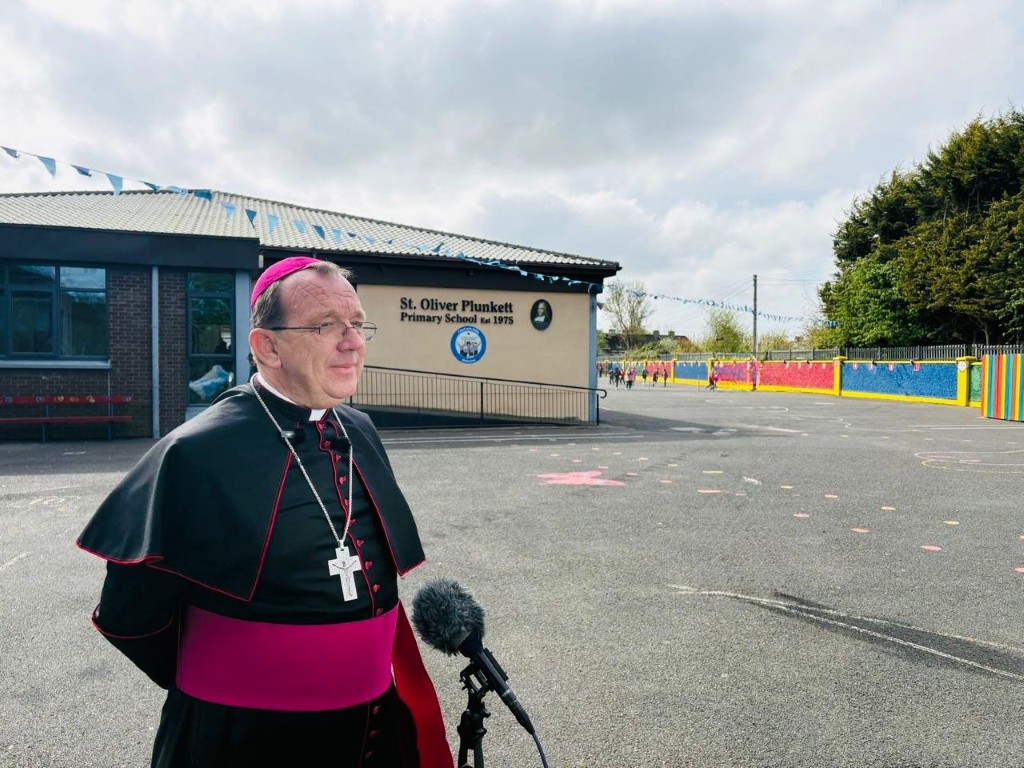
Today, we are celebrating the fiftieth anniversary of a Catholic, Parish, Primary school.
Catholic schools, like this one, have been in the news for the past number of years. Unfortunately, the discourse has not been on what the schools do; it has not been on the education, support and care that they provide; it has not been on the fact that these are popular schools, are well supported and serve their community while being genuinely inclusive, but it has, rather, been a more negative, ideologically driven and adversarial depiction of Catholic schools, like this one, as being grim places of indoctrination that children are forced to attend by Church and State. And of course, that discourse and narrative has been ill-informed and false.
Many of us have known this narrative to be untrue but, various groups, supported by funding from ideological philanthropical entities, many from outside the State, continue to lobby politicians and media with a rather narrow, nuanced and distorted narrative.
Some of that view can be accepted by society and at times, one could be forgiven for thinking that the Catholic school is the reason for every current ill in the world of Irish education!
Many years ago, an academic in the History Department in UCC, Dr Gabriel Doherty, who has since passed to eternal life, told me that it was a feature of the examination papers that he was correcting in Social History that every one of the social ills that Ireland had experienced was due, in the minds of his students, to the influence of the Catholic Church. Pure revisionism and an unreflective absorption of a particular and, perhaps, fashionable narrative.
Yes. There were atrocities. We share that shame. But Catholic orders and congregations were providing education long before free education in Ireland and religious congregations were providing care for those who were sick too. It is also important to note that those who offered those views were third level students and many were graduates of Catholic schools themselves. I attended a Presentation Sisters Primary school, a Christian Brothers Primary and Secondary School and when I was sick, I attended a Mercy Sisters Voluntary Hospital. I am certainly not alone in that regard.
We are almost at the point where some would want us to hide the fact that we are either patron of, teaching in, on the Board of, working at or attending or attended local, Catholic primary and post-primary schools. That is what happens when narratives are repeated, unchecked and blindly accepted.
Let me also say that independent and reputable research has indicated that Catholic schools are the most inclusive, not just in terms of religion but in terms of ability, socio-economic background, ethnic background and nationality. Saint Oliver’s is no exception, and I am thankful for and congratulate the school on that achievement. That is significant.
Saint Oliver’s is a Catholic Primary school that celebrates it’s fiftieth anniversary today with an open invitation to a celebration of Mass in the local Church as well as to a celebration in the school itself. I am delighted to be at both. It is important that the wider community see the work that this school, and so many others, is doing and can appreciate for themselves the happy, learning environment that has been created and is being sustained.
Saint Oliver’s is a school that has changed and developed over those years and adapted to a changing enrolment and demographic. It is a School that welcomes all local students, cares for them, allows them to reach their full potential and caters for their many and varied needs.
I know that you would like me to say this morning that Saint Oliver’s is unique in that regard but I can’t. Catholic schools throughout the country are doing exactly the same. It may be surprising to many but local communities know very well the work that their local Catholic primary schools do and, as a result, these schools are supported.
What I can say is that Saint Oliver’s School is a Catholic school under my patronage and I appreciate very much the efforts that the school Principal, Staff and Board are making to ensure that the school serves the local community, welcomes all students, caters for those students many needs and talents, respects those students, strives to make Jesus known and loved and recognizes that its many and varied students, in their own way, are made in the image and likeness of Christ.
I particularly appreciate the warm, happy learning environment that has been created and I, like many others, realise the work and effort that takes and I congratulate the schools in its success in that regard. That success is much more important for parents and students than a Fiftieth Anniversary celebration.
Earlier this month, we witnessed the broad release of the recent survey on divesting. Initial results seem to indicate that while there was a forty per cent response rate, over sixty per cent favoured their school remaining under Catholic ethos. While there were sixty percent of parents who did not participate, one would have to deduce that there is a greater likelihood that most of these would also be satisfied with the status quo. Those who want change are always more likely to vote.
Of those who participated nationally, over sixty percent wished their local school to remain under Catholic ethos. When one takes out those schools that overwhelmingly wish to change, and they exist in some areas, particularly in urban areas that have become multicultural, the percentage of those satisfied rises further for most local Catholic schools.
That is not surprising. In fact, it is most surprising that our journalists and many of our commentators and politicians are surprised. You and I know that Catholic schools like Saint Oliver’s are working well, serve local needs and offer an education to students that reflects their needs and abilities. Lived experience must inform one’s opinion and I suspect that has not been the case in the discussion on Catholic education.
We have had the survey on divesting. We have achieved a result. Granted, it is not the result that some predicted or would have wished for. But democracy, maturity, pluralism, respecting parental choice, and even inclusion itself, demand that we accept the result of that survey. Anything else would change the image of a reporter to that of an advocate or lobbyist and that would damage further the perception of objectivity that is integral to unbiased reporting in a democracy. Indeed, in other countries, the term ‘fake news’ has been applied to such a perceived scenario!
If there is a wish for divesting in any part of this diocese when the more detailed local school results are published, I, like the other bishops as patrons of Catholic schools, would happily engage with the Department of Education and Youth to initiate a closer examination of the wishes of parents and staff. If there is a wish for divesting, I would respect that and it would happen.
But, in the meantime, it must be acknowledged that:
• most schools, like Saint Oliver’s, have been serving the local community – and serving the community very well – for generations, and in this case for fifty years;
• our schools are inclusive and cater for students with a wide range of nationalities and abilities and from a wide range of socio-economic and ethnic backgrounds;
• our schools serve the needs of their pupils and have adapted over the years to cater for a changing demographic and a wide variety of student needs;
• our schools are Catholic and are known to be Catholic and, while they prepare their students for the reception of the Sacraments, they also respect and encourage difference and welcome students of all faiths and none;
• our schools are inclusive and do not refuse to enrol on the basis of faith or baptism;
• our schools are staffed by committed, competent and kind staff, and are not grim places of indoctrination in spite of criticism by some opposed to faith schools;
• our schools enjoy the support of their local communities;
• as reported on 7 April, the results of the Department’s survey on divesting indicate that the majority of parents in the local communities, wish to send their children to such Catholic schools, and that choice must be respected.